
Making goal on KS was just the beginning. The adrenaline rush, answering the congratulatory emails the thank-yous...rip that needle off the record and wake up! (As if I'd slept a wink in the last few weeks.)
China was the first thing to deal with. Not only did it have the longest production time (or so I thought), but it was the furthest away in time, space and language and there's always US Customs between me and my stuff. Usually there aren't any issues, but....
All OK there, but there was going to be a shipping issue which I took care of right away. It turned out to my advantage later on in the production chain.
The duratrans needed some work in the processing, but it's all done, and they're coming in one by one after a few prototypes. Funny that a colleague brought her class to see what I was up to, since she teaches about the technical intricacies of communication--a significant component of this installation. The students (college freshmen) had never seen a duratrans--or LED panel for that matter--up close, though they had passed by many, many of them in their treks through NYC.
The dura showed slices of the images from the installation. One of the students said that he liked the prototype and asked whether it was for sale, that he'd buy it.
Now that was a shock. The student's reaction took me by surprise since I didn't think that prototypes would impress much of anyone, let alone an 18-year old in an into graphic communications class. However this did shed yet another light on installation art and why it is so difficult to make and fund. The experience can't be sold, that's ridiculous. The materials that make up the components can't be sold, either. So what is the ultimate value that the viewer can bring away with them, other than the snapshot they've taken with their phone?
Looking back to when The Gates by Christo and Jeanne-Claude, the prototypes and drawings were what collectors flocked to, while the tourists got the souvenirs: the book, the coffee mugs, etc.
Other puzzle pieces: the electronics being patched since parts don't always work as planned; changes must be made. A small assembly line was set up in one of the labs at City Tech and Remy diligently pieced everything together with a rare expletive when the soldering iron got a little close. There's a lot going on; and while it works well, I have a feeling the unit's gonna get an overhaul after Trenton, as had happened with SMV.
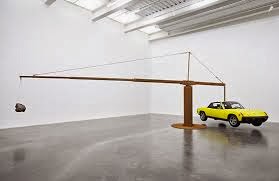
Suspended works are incredibly seductive, and while I haven't gotten around to seeing Chris Burden at the New Museum yet, I plan to get over the next few days. I long to see the Porsche balanced with a rock at the long end of a see-saw. How magnificent is that?
 Anyway, I found, through the exhibition staff at ArtWorks, a theatre rigger who will install an armature to the ceiling and from it, hang the pieces. He's doing the work within my budget, though I had to rearrange things a bit. The crate with the LEDs came into to LA rather than NYC and shipped ground via train and truck, saving money. It got here fine, but there is a little stress, and I love that.
I sent the rigger the sketch and we're meeting this week to put it up. Wow. It's so real now. It's a ton of fun but there's still a ways to go. The longest two weeks of my life. Sounds familiar.
China was the first thing to deal with. Not only did it have the longest production time (or so I thought), but it was the furthest away in time, space and language and there's always US Customs between me and my stuff. Usually there aren't any issues, but....
All OK there, but there was going to be a shipping issue which I took care of right away. It turned out to my advantage later on in the production chain.
The duratrans needed some work in the processing, but it's all done, and they're coming in one by one after a few prototypes. Funny that a colleague brought her class to see what I was up to, since she teaches about the technical intricacies of communication--a significant component of this installation. The students (college freshmen) had never seen a duratrans--or LED panel for that matter--up close, though they had passed by many, many of them in their treks through NYC.
 |
| Slices of the eight images set for proofing. |
Now that was a shock. The student's reaction took me by surprise since I didn't think that prototypes would impress much of anyone, let alone an 18-year old in an into graphic communications class. However this did shed yet another light on installation art and why it is so difficult to make and fund. The experience can't be sold, that's ridiculous. The materials that make up the components can't be sold, either. So what is the ultimate value that the viewer can bring away with them, other than the snapshot they've taken with their phone?
 |
| One of Christo's many sketches for The Gates. |
Other puzzle pieces: the electronics being patched since parts don't always work as planned; changes must be made. A small assembly line was set up in one of the labs at City Tech and Remy diligently pieced everything together with a rare expletive when the soldering iron got a little close. There's a lot going on; and while it works well, I have a feeling the unit's gonna get an overhaul after Trenton, as had happened with SMV.
Suspended works are incredibly seductive, and while I haven't gotten around to seeing Chris Burden at the New Museum yet, I plan to get over the next few days. I long to see the Porsche balanced with a rock at the long end of a see-saw. How magnificent is that?
 Anyway, I found, through the exhibition staff at ArtWorks, a theatre rigger who will install an armature to the ceiling and from it, hang the pieces. He's doing the work within my budget, though I had to rearrange things a bit. The crate with the LEDs came into to LA rather than NYC and shipped ground via train and truck, saving money. It got here fine, but there is a little stress, and I love that.
 |
| The ArtLab in Trenton with some slapped-together still images and the nine images planted in the space. |


