Description


Steel Ice & Stone is a multi-media interactive installation.
Nine suspended LED panels and sensor-triggered sound create an environment for memory recall.

Showing posts with label Sinu. Show all posts

Monday, June 5, 2017

Sticks, Mud and Plaster

To understand why a still-standing hundred-year-old house is a phenomenon, some attention must be given to construction on the north coast of Colombia at the time.

In most of the US, we had much different building techniques due to our need of keeping warm in the winter. Although most places have hot summers, a lot of the US--even the deep South--can and do get snowfalls, even in this age of global warming.

No such thing in this Colombian town. The area I'm drawn to is in the winding delta of the Sinú River, a plain of fertile soil and twice-daily rainfall, once home to the finest indigenous goldsmiths in all of South America.

The homes built around the turn of the 1900s all needed to provide shelter from the sun and rain. Other provisions, but not many, had be made for fungi and moss that grow in the dark, warm, shade. Nothing lasts too long under these conditions, except, a significant element of the population, but I'll write about them another time.

The houses were made by reeds nailed to a hard wood frame. Mud (usually cow manure) was stuffed into the cracks on both sides, and finally, plaster with casein was troweled on. Several coats of oil-based paint sealed the deal, with occasional patch-ups.

The ceilings are high, and the roofs are made from corrugated sheet metal. In some areas, curved brick is put on top of this, but mostly not. Instead, sometimes the roofs are thatched with dried palms.
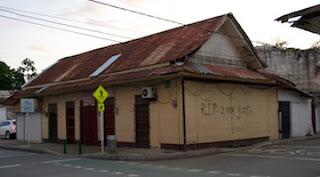
There are bars on every window and two-level shutters for the afternoon and nighttime. These homes do not have screens, since the insects in the area can easily enter the standard mesh. Instead, people used mosquito nets; I discovered some still cling to that tradition.


Sunday, June 4, 2017

One Day a Hundred Years Ago

I had the opportunity to meet with an architect from the mayor's office in Monteria. Dr. Luis Eduardo Puche. He's at the helm of developing an historic quarter for this passed-over city. The project involves an investigation to evaluate, repurpose, rehabilitate where possible, and ultimately preserve the architecture of a a town that blossomed into a city and is bursting at new seams every few years.

As stated in other posts, the town was once a livestock processing center, with cattle health care and evaluation, auctions, bull fights, etc. Roads weren't paved to facilitate the cattle moving from place to place (trucks do that now...) and hey, who needs sewers in that case? When I visited Oklahoma City's Stockyards I saw similarities.

Built around 1900 from mud, piles and plaster, this house is
inhabited by descendants of its owner.
Cattle brings a lot of money; and other land industries sprung up--cotton and sorghum farming. The village was a kluge of shops selling all kinds of wares--purveyors of cowboy products like saddles, feed, twine, barbed wire and the like. Fabrics made from the fine cotton grown nearby went into making clothes and of course, there were food markets.

This kind of living brought about a type of planation living for the wealthy, even though it was edging toward an urban environment. Entertainment, night clubs, and restaurants weren't a large part of the flow of life, since these needs were better served by older, more established cities like Cartagena, Medellin or the capital, Bogota. Instead, entertaining at home was the chief activity, and most participated--even if it was a pre-dinner walk to visit friends in the late afternoon.

Back to Dr. Pucha: He gave me PDFs of the proposals and reports he's put together for the mayor's office of planning and development, which detail the blocks and lots in the oldest part of town. Houses are separated by age, and notes which have been demolished, which suits me perfectly.

I've identified 21 structures that may have been frequented by my subject; and  this web will widen. I plan on visiting them all, early in the morning, since the heat is outrageous. Sunrise at 6:00 and sunset 12 hours later, doesn't make things easier. But the adventure is that I'm never sure what I will find. 

Tuesday, March 15, 2016

It's Been A Year

New project on the horizon, called Finding the Sky, the story of a centenarian's memories.

I'm thinking about this project as random memory; its delivery is imagined as downloaded motion media; and the jump to video and random download will be the true experiment. Already in the throes of acquiring funding and searching for an exhibition venue, the piece is snowballing with concepts.

Starting from the beginning:

I met someone who was turning 100 years old. When someone lives to have seen a century pass by, tapping into memories becomes a different type of journey. As the day of his 100th birthday grows closer, the memories seem to coalesce.

What questions would I pose? Everything I could think of was painfully insipid:

"What do you remember as the most important event of your life?"
"What you remember most often?"
"Is there anything that happened in your life that occurred again in a different circumstance, different place?"
"Is there anyone you've known for your entire life--that you can remember?"
"Where do you remember a significant event occurring in your life?"

Note the two-layered roof to allow cool air to
enter from the top and the watery streets in front.
The front porch served as a sidewalk.

I did find out the person was born and grew up in a remote village in northern Colombia. A member of a large family, most of his siblings had lived to be over 90. Another older brother still lives with his wife in the town which has grown into a major city not far from the Panamanian border.

According to the blog from which this
image was borrowed, this house belonged
to a one of the French families of
Monteria.


The stories started slowly, but began weaving a web as the memories extended farther and farther into the past.

Some quick research revealed a French population in the area dating from when the Panama Canal was built--before Teddy Roosevelt and his bunch instigated the revolution that turned Panama into an independent country and the Canal Zone into US territory. Some photos show the slow plantation lives that developed from those of military or engineering tradition.

In slowly recounted tales, the man mused that
the childhood memories he cherished most were those that he no longer had access to: those of Model T's wading through the muddy streets, layered with the croak of frogs and crickets, the rustling of thick gardenia leaves in the trade winds.

All were gone with modernization, perhaps; extinct as anything too mundane to be remembered.