Description


Steel Ice & Stone is a multi-media interactive installation.
Nine suspended LED panels and sensor-triggered sound create an environment for memory recall.

Tuesday, June 18, 2013

I'm Beginning to see the LED

Expressed in a completely different context, Lou Reed's words resonate with me this morning. Of course, his iconic song was "I'm Beginning to See the Light".

All kidding aside, I was online this morning with an LED supplier from China.  I love the Internet. I can get my 4-x-5 foot [1200 x 1500mm] panels from there.

A few things in the works: the frame around the edges is 300mm, [just shy of 1.25 in]. Off the shelf it's a shiny black, but the manufacturer will get back to me if the finish can be matted down.


The back is PVC which he said I can have in black; and the extra work to install the hanging hardware will be in the quote. If it's reasonable, I'll get a sample. Even if it needs some extra finishing, I'd be willing to do it. The hardest thing would be to refinish the frames, but I did something similar with See My Voice (the hinges for the two triptychs). With that project, I anodized them with some lethal chemical that's probably illegal now.

I'd order the sample with the hanging hardware in place. Maybe I'll like it and I won't have to drill it and finish it myself. I'm prepared--happy--to do it, though. This is the fun part because you're sewing up the little details that only you will see but brings the piece to another level and makes it truly spectacular.

He sent images of another product, an LED box with a very thin frame around the edges. The problem with that is the image substrate. Because the frame is so thin, the image is on a fabric-type material, which I imagine is ink-jet pigment (not an exposed light-sensitive material), which, I believe, wouldn't give me the hard edge that a duratrans does and that I want. I have an email out to my duratrans supplier as well.

I'll post details as they happen; I know you're out there cheering me on.

Sunday, June 16, 2013

Many Avenues

Arrived at a crossroads, and the installation blasts off from here. On the table:
A Crossfield drum scanner. The 4x5
transparencies are coated in a spe-
cial oil and affixed to the cylinder
(drum). The drum spins while the scan
is made by a laser reading the density of
the images's dye particles and creates a
digital file: RGB or CMYK.
If I make the LED panels instead of mounted prints:

    a) new scans are needed to make the Duratrans films. The last price I got was from a fellow in Colorado for $200 each. Big scans. The final images need that much data. I'm not sure if he's gonna run a sale in the summer like he did last year, but if he does, I'm there.

    b) before any scans are made, I've gotta see if I'm gonna like the results. What if the LED panels look tacky, gimmicky? Yes, it sounds cool to have giant rectangles hanging in mid-air that emit light, but what encases them has to be in the material that I want, and a thickness that doesn't interfere with the design of the piece. NOTE: the actual lights are encased in the outer frame and, through a series of prisms in a type of honeycomb, the entire panel is lit.
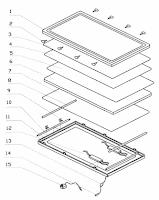
         
    c) To consider is the cost of the LED boxes themselves. I got an estimate of the 4x5 foot LED panels just shy of $1300 each. Everyone has said that's cheap--but they're not paying for it! And, I can contribute something, but by the time it's all said and done, we've hit $13,000. (Nine panels plus one back-up).

    d) And then there are the Duratrans. Lambda for Less in Michigan is having a sale this month, but I won't be able to make it in time. Things need to be tested and I can't afford to make any mistakes. They're pretty cool out there; their prices are reasonable because they supply the entire roll of exposed and processed Duratrans film and you do the rest. I'm probably gonna have them trim it because I don't have a table that size to work on the finished prints and I'm sure they're set up for it. The last time I used them was for the show in Kinderhook. They printed seventeen 15 x 45-inch [38 x 114 cm] and three 24-inch [61 cm] square prints and mounted them on archival Sintra in ten days after tests were uploaded. I have to call them to cost it out, also this week.

First things first. I'm going out to the manufacturer this week to see what they've got and how it looks. I'm gonna buy a small one and, with a scan I already have of one of the images, I'll send out to Michigan to have a prototype made.

But now the critical boring part: It's starting to look like $18,000.00 without electronics.

I'm gonna need 18 of these.          
I had lowered my Kickstarter goal to $10,000, because of re-addressed engineering costs but that was before the LEDs came into the picture. This new avenue might completely confuse backers, since now I'm seeking funding to supply the images, as well as the electronics.

So, this week, I also have to plan some damage control.

Friday, June 14, 2013

Electronic Birds

Since their inception in 1970, Kraftwerk produced eight albums, with a new rumored on the way (I've been getting tweets that Ralf Hütter has announced it on a few outlets). Known for their direct and succinct view of technology and its effects, one of my all-time favorites is a little-played cut, "Morganspaziergang" (Morning Walk).

My adventures with Germany brought me to Cologne (not far from Düsseldorf, where Krafterk is based) a number of times in the late 1990's. I lived in a small western suburb of Cologne for a summer when fulfilling an artist residency clear on the other side of the city in Deutz.
A concept poster for a 2005 Kraftwek
concert in Los Angeles, by the artist Emek.

Up at the crack of dawn as I always, I'd walk down to train station and on the way, get the morning bread and coffee. German summers and neither hot nor cold, and they see direct sunlight only on occasion. The long days pass by under varying degrees of cloud cover. This makes for lush gardens, trees and shrubs, inhabited by a chorus of birds.

That's when and where I understood the clip from "Morganspaziergang". I'm not authorized to upload it here, but it's readily available. Below is the audio from YouTube with the Autobahn cover where the it appeared. Bird songs are synthesized from flutes and electronic instruments custom made by various engineers.

Hütter and Florian Schneider, one of the founding members who left in 2008, together hold patents on one of the electronic instruments they use in their work; their secretive Kling Klang Studio is a technological workplace that accepts no mail or visitors (if its location is so secret, I wonder how they'd get any mail in the first place). They're notoriously reclusive, so I'm not expecting a response to my tweet for any contribution or comment.

Tuesday, June 11, 2013

Make Room....

Just as important as doing the work is funding it and, ultimately, selling it. That's how artists strive to make a living. It's also, how a friend put it, the necessary way to maintain living space. Long ago I worked on an NEA-funded project with a writer about forgotten Queens burial grounds. The documentary took a long time to complete and was long in getting exhibited. Eventually, the prints made it into the Municipal Art Society of New York, a truly altruistic organization once around the corner from St. Patrick's Cathedral, now on 57th Street and Sixth Avenue.

The exhibition was up to great success; I had very little to do with it and remember feeling a left out of the process, yet a little guilty. The remark that still sticks, after all this time, was the writer's poignant question: "OK, whose apartment does this get stored in?"

Something to consider. This is New York City after all, where the rent on a parking space could cover the mortgage on an apartment anywhere but Moscow.

An artist friend who's vanished in the wilds of Berlin also commented that one of the deciding reasons he'd stopped doing physical art works was the improbability of not selling them and not having the means to store them. Exciting concept pieces like one shown in Madison Square which, through ocular displacement, makes the Flat Iron Building disappear, was among his exhibited works.

Despite these and other professional successes, the life of a conceptual artist, no matter how brilliant the work, is financially disastrous. Our little town devoured him and he left. Before going, he gave away pieces; since logically, he couldn't destroy his work. I have one of his smaller ones, as do some of my friends.

What to do with nine--count 'em, nine!--4 x 5-foot [126 x 154 cm] panels of SIS? While the pain is agonizing, some options exist. Mana Contemporary, an art handling and storage facility reported by the WSJ a few years ago, offers its services to represented artists. Once a safe and convenient place in NJ to store pieces and show them informally to collectors and gallery owners alike, it now offers "gallery"-type exhibition space, framing, crating and transportation--underscoring that there just isn't enough room in NYC for its art community, one of the proudest feathers in our cap.

Saturday, June 8, 2013

Explosion Interrupted

Yet more on suspended pieces. Damián Ortega, a Mexican-born artist working in Berlin, creates a number of suspended works.
While Ortega's career was launched with deconstructed vehicles that are then rebuilt in mid-air, "Cosmic Thing", the exploded VW that made it to the Venice Biennale in 2003 looks little more than an instruction manual drawing, despite its underlying critical view of the nagging legacy of the Beetle.

On the other hand, the elegant "Materialista" (2008) is a 24-foot (6 m) constellation of the chrome parts of a tractor trailer. The name derives from the term used for trucks transporting cement and other heavy construction  materials; the clean, crisp chrome and glass components of the truck actively combat the weight of its imagined contents. Leeji Choi wrote of it in 2009:  "this materialism is related not only with the power of matter and antimatter, but also with the logic of values in the art market where the value is attributed to the objects not always visible".

Some are more abstract works like "Champ de Vision", a suspended mosaic of 6,000 discs in translucent colors that can be ambled through, but from a distance, form an open eye. I'll write about this piece in another post.

"Controller of the Universe" (2009) is an assembly of used hand tools Ortega acquired at garage sales. It was installed at different locations and I can't tell from the various exhibition images if the installation was identical each time. In the photograph from the installation at the Cleveland Museum of Art through September 29, the work appears to be an explosion, frozen at a decisive moment, whereas the image above gives the impression of being able to walk through an onslaught of hardware repurposed as weapons. Both send stirring, if contrasting messages on the relationship between a builder and how/what is built and the society that plays the hinge pin between the two.

References: 

http://www.mymodernmet.com/profiles/blogs/damian-ortegas-incredible
http://www.clevelandart.org/events/exhibitions/damián-ortega


Thursday, June 6, 2013

Suspended animation

More on hanging pieces.

What is the purpose of hanging stuff from the ceiling? I've asked myself as this installation seems to morph on a weekly basis. Hanging a work using transparent filament makes it float, making the experience surreal, approaching a dream quality. If anyone has other ideas, bring them on!

Searching the Net and my memory banks for references on hanging pieces, I notice that hanging artworks usually do not allow for viewers to walk around them.  [Note: there are plenty of samples to contradict me, but I'm aware of those and I'll write about them in another post.] Perhaps that inaccessibility is what makes them all the more evocative.

In this search, I fell upon a post about a "provocative" suspended artwork by Bohyun Yoon, a South Korean artist who emigrated to the US and now lives and works in Richmond, VA.


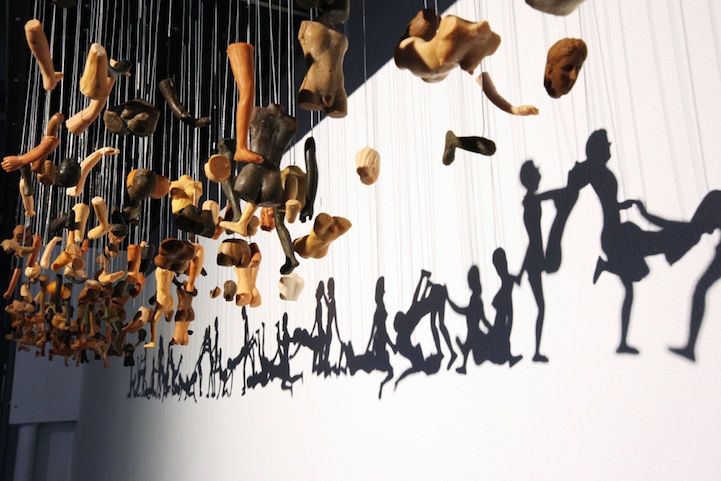
In "Unity", the shadows cast by the suspension of dismembered doll parts show the human shape in various forms of sex play, sure to get a charge. Perhaps a primordial phase of this work, created in 2007, is "Structure of Shadow", another suspended work using dismembered figures in a multi-layered apartment building-like structure in the gallery space.

Of all his suspended pieces, Neighbors (2012) is perhaps the best developed, although it is reminiscent of work done in the Ruhrgebiet 20 years ago.

One of the revolving splash pages to his website is the cross-reflection of--you guessed it--young nude 

Oh please. I didn't see a shred of technology implemented in any of the work, and only one piece may have employed it in its execution. Every installation appears to be hand-made and analog; and none of it explores technology's relationship to reality and illusion unless the mirror is on the technological cutting edge and the reflected image is a treatment of that relationship.

His most interactive piece, "The Glass Helmet" is a pair of rather handsome ewer-like handblown glass skull caps from which the wearer pours water into another's. This project is a little more compelling, but I don't see that any of his pieces delve into the evolution of human perception in the wake of technology.

Back to SIS: I await the bids from the LED suppliers. It becomes difficult to think about a piece without an approximation of what the final material will be; considering that I'm utilizing a commercial product to express something in a different, unintended purpose.

Then again, when I printed the images for SIS using lambdas, I also employed a commercial medium--the best one to make the large size prints I needed. We've changed the way we think about the image, its creation and its production, remembering that they were called "proofs" by the technicians who ripped them from the digital files.

Sunday, June 2, 2013

A Tip from Charlie Sheen

When I went to the Kickstarter info-session two weeks ago, a suggestion for one of the rewards offered to potential backers was a voice-mail thank you if the project was successful.

Who would want something like that, from someone like me? thought I, cynic that I am. I shrugged it off in disbelief, though a seed was planted.

Hearing that people have hundreds of thousands of followers--celebs, yes, but plebeians?--I was tooling around Twitter, which, to confess, is still a mystery to me (A daily dose of Anita Giraldo's Steel Ice & Stone?  Gimme a break!), when my fingers tapped out the name of the king of all folk heroes: Charlie Sheen.

He has over 9 million followers! Good for him. What I find far more interesting is that he has a mere 1500 tweets. I'm not a particularly curious sort to scroll down to see the history, but seeing his posting pattern, he can go for a week--some times more--without a word.

Anyway, what caught my eye a week or so ago was the still-fresh post saying that Charlie himself would call your mom and wish her a happy Mother's Day. Shucks, I'd wish I known, since my mother has been getting daily doses of Charlie in the NY Post since his meltdown two years ago and she would have loved to hear from him.

I clicked the link directing me to his message (bit.ly/11W4TcD)  and it dropped me on to an entire site dedicated to this activity, with all kinds of celebrities--not just Charlie. Click on the picture of your heart-throb (there aren't as many as you would think), and you're transported to a fan-page with a paragraph studded with pull-down menus to fill in the blanks. The blanks allow you to personalize the message of your choice, and, with a payment of just $ 3.99, Charlie will talk to your mom, wish a loved one a happy birthday, or even urge your coworker into rehab (chortle!).

Now this is a racket!