Description


Steel Ice & Stone is a multi-media interactive installation.
Nine suspended LED panels and sensor-triggered sound create an environment for memory recall.

Friday, September 27, 2013

Belief and Conviction

Past the midway point, my installation is 25% funded. While I have a feeling I will made goal, it's going to be a difficult and probably painful journey indeed. Not that the platform or anything about the process is disappointing, but the challenge of launching something like this is not too different from launching a political campaign, with similar processes, tensions and outcomes.

I worked on a presidential campaign--made the trips to Ohio and Pennsylvania and all the etceteras--not with the belief that my candidate was going to win; no, no. My candidate HAD to win. What he believed in was that important, and I believed, important for my fellow citizens. 

That conviction is what's needed when launching a crowd funding campaign. It's what fuels the resourcefulness, it's what makes strategies turn on a dime and switch paths in doing one thing: Getting a message across clearly.


Kickstarting an installation is like a presidential campaign in other ways: It's all or nothing. Either you're the president, or…you're not. Either you're funded, or not. Also, it's a highly targeted media blitz that pulls in smarts from every genre of creativity. What I find the greatest similarity, however, is that, funding an installation, just like campaigning for president, is getting people to believe in your idea, your passion, your experience. There's nothing tenable, not an ounce of predictability or guarantee. Just a belief in a promise and this is quite unlike other types of projects like products, games or technology--even fine art ones like painting.

Ultimately, it's what makes getting there so challenging and so rewarding.

Two people I know--a friend and a colleague--each funded their installations on Kickstarter. I know others who have successfully funded work there, but I refer to these two because they were able to fund experimental conceptual experiential work. And while I've backed eight projects on KS, I've watched none more that the Echoes Exhibit, an installation done by Teresa Flowers.

She, too, tried to fund an experience, and succeeded. But not easily, as her FB feed attests. I get the feeling it won't be much different for me. 

Saturday, September 21, 2013

As the World Turns

The posts will get shorter over the next two weeks since a lot of time will be spent communicating with backers and potential ones, urging them to pledge. However, the network for the installation has grown, with well-wishers and fans around the world. True, the LED manufacturer has a vested interest in SIS, but the LED guy photographing the guys at the plant and sending me the shots is totally fun. I'm quite moved by it.


Look at this place! The shop looks clean enough to eat off the floor. In a few weeks I look forward to my stuff being built there. And while my KS is having a rough time, I'm confident that shaking up my would-be backers will get me there.


Other things has progressed this week on a technical side. In search of ideas on how to get this installation to fly (hang actually), I went to the shop in the college where I work to see what ideas could be offered. We have a full stage technology lab in our Entertainment Technology Department where students learn and sometimes develop the technology surrounding live performance. What better place than that?

The lab technician suggested that rather than hooks, using cable clamps with thimbles would do the trick. Two clamps for each wire for reinforcement, and it's fully adjustable. Great, another thing out of the way.

Didn't get to Trenton yesterday since I was having a video crisis.

But it was solved again, thanks to the handy Internet. I downloaded a sound program and edited a new sound piece, slapped together some images from another app I got from the web, and I have the new 1m45s vid below.

It's really short but I believe it says it all.

Repeating what I've been saying on this blog: This work, as with many conceptual works and performance pieces, loses everything in the translation off-site. While photos and videos help, nothing comes close to walking in the room, sliding  past the intricate images, taking in the sound and welcoming the revelation that has come into your head. 

Tuesday, September 17, 2013

Dancing From the Ceiling


Time and again I find myself contextualizing my work by looking at parallel installations. This comes after a visit to the ArtWorks in Trenton last Friday and discussions with its exhibition director and my engineer buddy on how to hang this work.

The top of the historic building is supported by an iron frame, not always criss-crossing in a place convenient to where I want my pieces to hang. So this leaves me looking for either a rigger to install scaffolding from which to hang nine 35-pound panels or modifying the grid above by joining metal tubing and hanging the pieces from there.


The video shows the ceiling of ArtWorks. While some think it's gonna be a snap to join pipe and hang the panels, I'm already losing sleep. However, while I was originally thinking of having the LED guys in China install long cable on the panels, I'm gonna instead have them install lengths of 3 meters (nine feet) . From there, I'll attach hooks. To the pipes above, I'd install heavy-duty cable, finishing with hooks.

Borrowing generously from the blog, thisiscolossal.com, I've looked at the eight or so pages of their entries, poring over the methods artists used for hanging works. A white grid hangs from the ceiling of an art museum in Istanbul from which hundreds of books suspend.

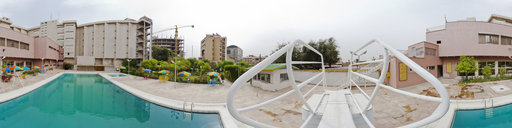
I'm not wild about this particular work attributed to Hanif Shoaei. [He also works as a photographer in his native Iran, and creates quite inspiring panoramic works--another of my weaknesses, but that's another conversation.] 

Visiting the link allows the viewer to move the full 360. http://www.360cities.net/image/on-diving-board-iran

Many other suspended works are shown Colossal, and many, quite beautiful. But, I lean toward suspended sculptures that can be interacted with by walking through. 

High on the list are the rope sculptures suspended outdoors by Italian sculptor Moneyless. More of his work can be seen at his gallery's website, http://www.unurth.com/Moneyless-San-Francisco-Oakland; as well as his own, www.moneyless.it. The image I've included just whets the appetite. His site shows his thought process through drawings and paintings, in which he fuses perfect geometry in the haphazard natural environment as a rite of purification. Lovely work. 

Returning to the reasons why SIS must be a suspended work is the need for the viewer to walk around the panels. The installation's intent is for the viewer to accomplish a number for tasks: on a basic level, they are needed to trip the sensors otherwise the installation is silent. On the conceptual level, this work is for the viewer, through the abstract media, to connect to a remote nuance in their past. Putting images on pedestals makes it [already said] pedestrian!

The exhibition director at ArtWorks had voiced concern about bringing a scaffold from which to suspend the works: Any kind of roof overhead would render the space claustrophobic and ruin the sensation of light-emitting rectangles floating in mid-air. 

He's right. I'm boxing with this as my Kickstarter gets off to a very slow start. [Sigh].

Friday, September 6, 2013

The Biomorphic Form

With affordable 3D printers bursting on the scene, many artists' and designers' response is to utilize the replicating shape creating streams and chains that build on one another into more complex shapes, much the way the DNA molecule helixes itself into proteins that make up organisms.

One is Skylar Tibbits an artist, architect and scientist from the MIT Media lab and winner of the Ars Electronica Next Wave prize. He's the talk of the town with his inclusion in other shows, notably the one I saw at The New School's Gallery on Fifth Avenue.

Mr. Tibbits works with the forms and shapes making up his sculptures as building units; they strongly evoke biological forms, at first appearing haphazard and chaotic, but in fact, creating an order in which their irregularities make them more amenable, understandable and approachable. Suspending the works adds to their surreal quality; allowing the viewer to walk through their arrangement envelops them as if they are in a journey through themselves.


In February he presented his development of a self-building lab at a TED Talk in which the process to make his work goes one step further: works themselves are programmed at the material's structure level, and programming extends to the sculptures erecting themselves. The designer (or artist, if you will) programs the path of construction to achieve the shape or function by supplying a simple energy source. I venture to say the animation itself could be part of the art form.

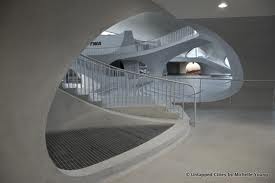
The 3D lab recently unveiled at the school where I teach, The New York City College of Technology (City Tech), showed off their latest creations from the architecture school in a small but thorough exhibition in the lobby of Voorhees Hall at the foot of the Manhattan Bridge. Simple shapes, programmed to replicate and arrange themselves, achieve structures approaching protein arrangements and shell patterns, some suspended as if in a primordial soup of their own, calling back to the TWA Building at JFK.

One of the entryways to the main
lobby of the TWA Terminal, de-
signed by Eero Saarinen in 1956. He
surely didn't have a 3D printer, though
3D printers are being developed for
building construction.
Not using the 3D printer but utilizing enormous spaces and sometimes self-engineered machines, Tim Hawkinson creates suspended environments for viewers to walk through intestines (presumably his own, since much of his work is self-confronting). I've seen his shows at the Ace Gallery and the Whitney throughout the years; and like Mr. Tibbets, Hawkinson concerns himself with the creation process--calling it production is not appropriate here--going so far to design and build the machines that make his art.

Among my many favorites is a piece that employs a studded phonograph turntable that jolts the arm into writing his signature. A conveyor pulls the paper through a scissor set to a timer, shearing the slips of paper, landing in a pile, shown below. What's endearing is the use of analog components, kluged to make the machine/contraption/sculpture. It dissolves any glimmer of manufacture. Magnificent.

And while we haven't heard much of him here as yet, Jang Yong Son has created a collection of blissfully organic pieces from small steel tubular components welded together until large, intricate forms reminiscent of microscopic images of bacteria (referred to by the art blogging site ThisIsColossal.com as an amoeba) are formed.

The sculptor does not employ the 3D printer, crafting the scultures by hand. However, the precision--and size--of the work make it breathtaking, as do the irregularities that give it credence and affability. He too, suspends some of his sculptures, much to the delight of the viewer.

Bathsheba Grossman, an early 3D printer artist is a mathematician turned artist. Saying of herself that she explores the world between math and art, she takes inspiration from nature such as pollen, viruses, jelly fish. These seem to be the evocative shapes at the moment; but an argument awakens about the programming of the printer and production of the sculptures.

Tusk, by Bethsheba
Grossman
When a machine can be programmed to sculpt an image, is it a craft or an art? Does perfect symmetry turn the object into a mathematical rendering? Or, going further, is programming an irregularity part of the creating process rather than building or manufacturing process? Can art be a product? Of course. The persistent discussion of art and philosophy of the 20th Century was precisely where do we draw the line between the sacred art piece and its replication--and, is its value the ability to reach the masses?

Clones of the image are manufactured all time, as with photography, and the original item retains its status as art while multiples are editions. But when the originals themselves are created using programmable, predictable means, are the pieces art or objects and is their multiplication called prints or units? What's the difference between an item coming off a litho press, a Heidelberg or a MakerBot?

Hawkinson's autograph machine.
A stinging observation was made by Otto Rank in Art and Artist in 1932: I paraphrase: the difference between a craftsman and an artist is that a craftsman knows what the finished piece will look like before he or she begins the work; whereas the artist who has brought a vision to the work, is also motivated by an exploration stemming from the self.  This caveat lays a path away from the original vision of the finished piece during the process, thus creating an art piece, not making one.


Tuesday, August 27, 2013

Real Ice

Anytime I see anything about ice in art I can't resist. Guilty pleasure? hardly. Aside from the cringe-fest of ice sculptures often found at weddings in Brighton Beach reception halls, there are studios creating complex works in this medium side-by-side with providing clients with crafted items surrounding special events. Okamoto Studio, taking themselves quite seriously, have a handsome website--complete with a video--detailing their philosophy and mission, as well as showing off the work they've done for a list of pricey clients. Far more impressive is their artwork, like the conceptual piece above, a lovely crystal bicycle glowing on the streets of NYC. One of a pregnant woman is on their website.

Another discussion. Remembering when I photographed the many, many pieces of ice for SIS. One was a chunk of ice I'd made in the freezer. Big deal. But, it photographed well and appeared to be much bigger than it really was, though I didn't select is as part of the nine. Another was--I like the "was"--a frosted-over kitchen window I discovered one morning as dawn was breaking. The 4x5 was always set up at that time, so I dashed to get some diffuser on the outside of the window and came up with Ice 2.

During that same winter, I came across a piece of ice that had separated from the curb. Dirt and grime imbedded in it, I hauled it upstairs, back lit it, and shot it so quickly I didn't notice that the top edge of the ice was in the image, a wonderful, unexpected mistake, creating Ice 1.

Olafur Elaiasson's installation at PS1 MoMA is a story all its own. The highly prolific Icelandic artist's work is quite at home in New York where it was prominently featured at MoMA and PS1 in 2008, his
waterfalls along the East River also in 2008, and currently, the exhibition of "Your Waste of Time" at Expo1: New York at PS1 in Long Island City. The installation consists of pieces of ice from a glacier in his native Iceland, presumably 800 years old. Global environmental issues are a recurring theme in his work, as he makes use of Iceland's seismically active landscape as inspiration and subject matter, photographing glaciers, sink holes, volcano explosions and floods. His work then evolves into experiential spectacles that have been exhibited internationally.

As for "Your Waste of Time", friends both in and outside the art world have issues with Mr. Elaiasson's piece: is it art?  Is it authentic? NYT editor Ken Johnson reported at the show's opening: "I couldn't help wondering: how much power does it take to keep the room so cold? A wall label explains that the cooling machinery is powered by solar panels temporarily installaed on PS1's roof. Still, what's the project's carbon footprint? Does raising awareness of a phenomenon that most viewers already know of make it worth the energy drain? Whose time is being wasted?"

My thoughts extend from there: Isn't this environmental theft?

The memory banks immediately circuit to Andy Goldsworthy, the master of environmental works. Using only his hands in making works in the naturally occurring landscape, he lovingly crafts sculptures from sorting, placing and layering the materials available at the sculpture's location. The beautiful stele at the left was carved from a piece of ice with a stone. The conduit of glowing ice circling a tree are icicles melted together by some water and the warmth of Goldsworthy's fingers.

The 90-minute documentary of his work, Rivers and Tides is available on iTunes and BlueRay. It is on YouTube as well, but the resolution isn't great so below is the two-minute trailer. About a minute in, the artist's fingers are shown melting the icicles to create the tree spiral.


A contributing factor to the magic of his work is the crisp photography, which captures the fleeting moments of true sight-specific work.


Unexpectedly, using ice as part of artists' discourse on environmental ravage enters the conversation in other art pubs. SIS, being about memory recall, couldn't be farther from that discourse.


Further reading:
http://www.icefantasies.com
http://www.okamotostudionyc.com
http://www.olafureliasson.net
http://topics.nytimes.com/top/reference/timestopics/people/e/olafur_eliasson/index.html

Friday, August 23, 2013

Onward!

So, I've ordered the parts mentioned in this post: http://steeliceandstone.blogspot.com/2013/08/tic-toc.html and have gotten to work on assembling them.

Good news: This is going smoothly. I'm currently following the documentation on this page: http://hem.passagen.se/communication/speach.html to program and test out our recording chip, the  ISD4002. I'm going to be using the Arduino as the USB to Serial adapter for programming. I have a USB to Serial adapter, but the Arduino is already set up for easily plugging wires around, and my adapter is not. https://dl.dropboxusercontent.com/u/40601652/2013-08-23%2015.45.23.jpg I'd either have to buy/make an adapter to have longer leads going from my adapter, or take it apart and solder in some wires.

Once that's programmed and working we'll program the second chip (same circuit, different sound), and code the Arduino to control both chips via SPI. Make a button to start one, make a button to start the other, they work as desired and we move along to the motion sensing and remote control calibration.

Current state: https://dl.dropboxusercontent.com/u/40601652/2013-08-23%2015.21.34.jpg
The chips on the breadboard, going top to bottom are the ISD4002, the LM386, and the PIC16F84A.
The two green wires are place holders. One is for the second chip to interface with the LM386, the other is the output sound to be connected to a speaker.
I'm aware that the resistors have rather long wires. Once this is working, I'll consider snipping them. I'm fond of reusing old materials in new projects though, so I'll put thought into it later.

Bad news: My assortment of resistors and capacitors does not provide me with all of the same things in the diagrams found on the site documenting their use of the ISD40002. More specifically, I have none of the capacitors with the uF and nF values labeled (except 4.7K), and I don't have any 1.5K resistors. I'd rather stick to a setup that seems to have already worked instead of deviating/tweaking it more than I already have before I find a need to. So programming is stalled until I get my hands on those.

Thursday, August 22, 2013

Getting Closer

As the relaunch date of my Kickstarter campaign approaches, I've been  increasing contact with several in the crowd funding circuit, asking for advice.

Crowd funding has become an industry, with many, many blogs, websites and marketing companies giving free advice or offering their services for a fee. I found this deplorable at first, because, as a fine artist, the crowd funding platform represents a way to get ideas realized in the ever-shrinking grant arena. And specifically for me, it's as difficult to find funding for highly experimental installation work as it is to find a venue to exhibit it. Now, to get a project funded I have to give someone a cut?!? But on exploration, employing a service might be advantageous because launching a project is enormously time-consuming in an area many artists abhor: Marketing.

A well-respected crowd funding consultant, Rose Spinelli (Crowdsourcing.org) commented on my posts on a LinkedIn Kickstarter forum that artists are often reluctant to launch a campaign and that perhaps writing about some of my experiences would reverse the trend. Talking to my artist buddies, culling stories and insights from around the web and adding snippets of my own, listed below are some reasons why I believe many fine artists often turn their backs on funding projects via social media platforms like KS or IGG:

1. Describing your project to convince a backer is different from describing it to convince a curator and artists don't know that. When writing about their work, artists concentrate on the meaning of the work, its intent and the concept behind what brought it into being. A backer is interested in that information, yes, but on a secondary or tertiary level. Rather, they want to be reasonably certain that if they give you money, the project will get done, hung, seen. The description must be geared toward them.

[Note: some say that patrons of platforms like KS rely very heavily on the rewards; and that installation art, performance art and fine art in general don't offer tenable goods in reward for a pledge. I disagree. If people who like art like your project and are convinced you'll bring it to fruition, they'll throw $10 at it to see it done. They believe in it and are happy to help you out, something much different from designers, inventors and their backers]

2. Putting in the time to build a social media following is something that many artists just don't have. Most are already working two jobs. See my post http://ow.ly/i/2tocC. I launched my first campaign in the spring which was only 28% funded before I took it down. During that time, it was even voted as a Staff Pick by KS. The percentage of people who contributed was exceedingly high, indicating an inspiring campaign. The problem was that not enough people saw that inspiring campaign.

So I embarked on building a following: a time-costly task. The tweets, the IMs, the chats, the follows and unfollows took hours out of each evening. But, using the computer as the tool to get my show done, I put in the time: emotional labor, as Seth Godin says, or, taking from Amanda Palmer: She'd rather sleep on a fan's couch if they had wifi rather than on a comfy bed in a hotel that didn't.

Has it paid off? Dunno if it will in KS terms. But something else has happened: a devoted awareness has developed for the installation itself--the core reason of making art. So, as artists grumble about one more thing to do on the road to making it (and I'm not going to go into what that means), they ought to take heart: lots of people found out about my work and they're excited about it. That cosmic energy always leads to something else, something good.

3. Putting together a video is sheer torture for almost all artists. While most artists have gotten to where they are because they possess some degree of extroverted self-centeredness, making love to the camera is tantamount to balancing a checkbook. They can hold conversations with anyone but a lens. My first launch's video had me introducing my work, and I hated it so much that I re-edited the whole thing with a voice-over. At a KS info-session I went to a few months ago, the verdict from hosts and guests alike was: get your face on it. Sigh.

4. The money chores and timing the launch around them is annoying to most artists. But, if cash is to be deposited to your account, grin and bear it.

5. The intense fear of asking others for money. Probably because many artists have done it before, they've had to field smirks and snorts of "Again?!?" Well, building a following is all about asking. And hand-in-hand with that, appreciating--every thing, every dime, every gesture as an acknowledgement of one's talent and ability. Perhaps in that light, some artists' fears and cynicism may melt away.

6. Having to explain "what went wrong." If goal isn't reached, "Again?" comes up, one more time. It's ego slashing. But sometimes that's all an artist has to keep going. It's the one thing that can't be taken away by anyone. Nothing wrong with a calloused ego as long as it's still there.

So where does that leave me, SIS and Kickstarter? I'll be talking about this more in the coming weeks. For now, please consider all the above as a chapter in my climb up the rocky ledge with the rain beating my face and a knife clenched in my teeth: sooner or later I'll get to the top.