Description


Steel Ice & Stone is a multi-media interactive installation.
Nine suspended LED panels and sensor-triggered sound create an environment for memory recall.

Saturday, April 26, 2014

Newly Wired

With the Brooklyn exhibition around the corner I had to make some sharp turns. The Kickstarter rewards were partially fulfilled, others are almost done and had pushed to the back burner until other critical issues were dealt with.

One was applying to a series of grants and festivals. That's a venture into uncertainty but one that must be undertaken nonetheless. The work has to get out there so venues are constantly being explored; since this is a work meant for public viewing, many of the exhibition spaces are awarded through competition. 

However, front and center was resolving the electronics.

Best efforts from my team for the first show yielded something that worked, but not dependably. Although Dr. Marantz is researching what is behind the inconsistencies and exploring a redesign to nail a two-sensor input and a single output, I had to face facts that we all have many pressing issues (called jobs) that get in the way of dedicating a large block of undisturbed time to come up with a new circuit. 

So I got a new engineer.


A new unit was designed, again programmed from an Arduino. An additional shield controls play/record details (the sound-corder chip on the original unit came with its own board), and the original sensors were scrapped for a new binocular one. The sound is transferred from the computer rather than recorded from the jack output and is contained on a micro chip. A card reader with a USB input transfers the data file.

It all fits in a box the size of a fat cigarette (what's that?) pack. The engineer delivered the new unit yesterday, and luckily the IRS owed me money so I could pay him off. 

Complain, complain: I'm miffed at myself for not specifying black wires to the IR sensor (they're white and red), so I have to shrink wrap those before show time. 
The engineer who designed and built the new units has a company of his own called Human Condition Global. They're all over the map with many different types of projects bound together by user interaction.

Recently, they developed an informational piece for a pharmaceutical company to introduce a new medication for those suffering from heart ailments and hypertension. They did so by outfitting a moving van trailer with booths and chairs, and flatscreen monitors. Each station also contains devises designed to effectively deliver the physical sensations of an oncoming heart condition such as a heart attack, angina or heart failure. The experiential exhibit's target audience are physicians who often never experienced these sensations. The trailer went to cities across the country where cardiologists were invited to "experience" what their patients suffer and the opportunity to learn about a new medication to combat the condition.

Back to Brooklyn, where anything of any significance seems to be taking place.

The Gowanus Ballroom's main space
The Gowanus Ballroom will show SIS in June; the date still being up in the air since the show preceding it may need a week to linger. I met with the curator last week and the space for SIS would be the entry, separated from the doorway and rest of the cavernous, two-tiered space by some heavy curtains. The curtains will be the same black rayon felt I got in a tiny store across from FIT (Fashion Institute of Technology) that hid the mass of wires exploding out of the units in the Trenton show.

I was introduced to a possible rigging engineer outside the college where I teach yesterday. In a few brief sentences I described what I needed, and the barrage of emails will begin again. I want to bring the Trenton guys back, but I don't think I can afford them and I'm close to being tapped. I sure wish I could bartend, though I don't have the looks. Just the dirty jokes. I guess another Kickstarter (heh, heh).

Next chapter, coming right up!

Thursday, March 20, 2014

Trail of Tears

A number of weeks--months--had to pass before mustering up the courage to post again.

From December 1st until just a few weeks ago I was consumed with the first showing of the installation in Trenton, NJ. An onslaught of bad weather and bad electronics made everyday from the last post until now a painful ordeal.

No amount of patient revise was able to make the electronics work beyond three units and it remains a mystery why they malfunctioned in the first place. As I figuratively shovel out from the weeks of ice and snow I've been under, I'm back in full force, planning for the forward thrust of the installation's next exhibition in Brooklyn's Gowanus Ballroom.

In the meantime, I'm in the process of uploading the sound from the pieces and internalizing a major change to the nine installation images. I exchanged one of the images of steel for another. The image used was of the steel threads spun from the inner shaft of a ship propellor; I recorded the borer that produced the threads and its sound is in one of the soundtracks. Visually it's abstract and evocative just like the sound coming from the machine that made it.

Some insights on the work and its evolution in the last hours:

In Trenton, I hired an engineer to rig the piece to the ceiling of the public art space, Trenton ArtWorks. It's a great old factory with a lot of history at its foundation and a steel frame work spans the building in both directions. As stated previously on this blog, I'd lost considerable sleep thinking about how nine pieces were gonna hang but the engineer said, no sweat. He's a theater guy, and he said the total weight  (300 lbs) was nothing and went to work with a colleague.

They ran extension cords and gaffer taped them to the wall with unsightly tape. Taking deep breaths, I thought, gosh, why does it have to look so slapped together?
However, I lost sight I was dealing with someone who puts together theatre productions. He's used to making things work while hiding others. Darkness goes a long way, I discovered.

By the time the lights went out and the LEDs were turned on, people walked around the exhibition space, drawn in by floating rectangles of light and sounds of who-knows-what but sounded cool. No one saw the bright orange extension cords or the gaffers. It was a hit. 


Brooklyn is next; another set of variables, another adventure.

Can't wait.


Above, the rigging engineers. A panel already hanging can
be seen behind the man on the right. Right: the installa-
tion when lit.

Sunday, December 1, 2013

Sleep is for the Weak

Making goal on KS was just the beginning. The adrenaline rush, answering the congratulatory emails the thank-yous...rip that needle off the record and wake up! (As if I'd slept a wink in the last few weeks.)

China was the first thing to deal with. Not only did it have the longest production time (or so I thought), but it was the furthest away in time, space and language and there's always US Customs between me and my stuff. Usually there aren't any issues, but....

All OK there, but there was going to be a shipping issue which I took care of right away. It turned out to my advantage later on in the production chain.

The duratrans needed some work in the processing, but it's all done, and they're coming in one by one after a few prototypes. Funny that a colleague brought her class to see what I was up to, since she teaches about the technical intricacies of communication--a significant component of this installation. The students (college freshmen) had never seen a duratrans--or LED panel for that matter--up close, though they had passed by many, many of them in their treks through NYC.

Slices of the eight images
set for proofing.
The dura showed slices of the images from the installation. One of the students said that he liked the prototype and asked whether it was for sale, that he'd buy it.

Now that was a shock. The student's reaction took me by surprise since I didn't think that prototypes would impress much of anyone, let alone an 18-year old in an into graphic communications class. However this did shed yet another light on installation art and why it is so difficult to make and fund. The experience can't be sold, that's ridiculous. The materials that make up the components can't be sold, either. So what is the ultimate value that the viewer can bring away with them, other than the snapshot they've taken with their phone?

One of Christo's many sketches for
The Gates.
Looking back to when The Gates by Christo and Jeanne-Claude, the prototypes and drawings were what collectors flocked to, while the tourists got the souvenirs: the book, the coffee mugs, etc.

Other puzzle pieces: the electronics being patched since parts don't always work as planned; changes must be made. A small assembly line was set up in one of the labs at City Tech and Remy diligently pieced everything together with a rare expletive when the soldering iron got a little close. There's a lot going on; and while it works well, I have a feeling the unit's gonna get an overhaul after Trenton, as had happened with SMV.

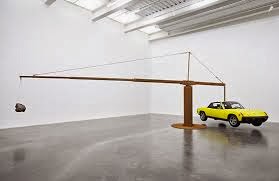
Suspended works are incredibly seductive, and while I haven't gotten around to seeing Chris Burden at the New Museum yet, I plan to get over the next few days. I long to see the Porsche balanced with a rock at the long end of a see-saw. How magnificent is that?

Anyway, I found, through the exhibition staff at ArtWorks, a theatre rigger who will install an armature to the ceiling and from it, hang the pieces. He's doing the work within my budget, though I had to rearrange things a bit. The crate with the LEDs came into to LA rather than NYC and shipped ground via train and truck, saving money. It got here fine, but there is a little stress, and I love that.

The ArtLab in Trenton with some slapped-together  still images and the nine images planted in the space. 
I sent the rigger the sketch and we're meeting this week to put it up. Wow. It's so real now. It's a ton of fun but there's still a ways to go. The longest two weeks of my life. Sounds familiar.

Monday, October 14, 2013

Dust Off and Take Off

I made my funding goal, with six hours to go. A backer bought a large piece that tipped my goal. I was with the engineers. After that, an additional two backers made pledges to bring the total funding to $10,165. Because I had one backer cancellation and another reducing the amount of their pledge, I stayed up to watch the seconds count down, keeping my fingers crossed. It felt great.

I was burnt to a crisp and needed to decompress. But today, I'm at it again, Skyping the LED guy to order the nine panels. He's sending me a PI (Proposed invoice, or RFP) tonight and I'll initiate payment. He says he can get me all nine units by the end of October; I say first week of November.

Also in the works is a new speaker. The original item is overkill for this project. Yes, it's nice, but I hadn't considered that there will be nine of them. While both venues are big, nine of the original units will blow the roof off them. I ordered a new, smaller one; I'll test it when it comes in at the end of the week. If I'm not confident I'll go back to the bigger one.

Wouldn't it be nice to have enough funds to outfit this project with those tiny BOSE speakers? However, I've already caught flack from "marketing expert" lookers-on that my KS goal of $ 10,000 was too high, as if they did any research to see how much things cost. Annoying, but I don't have time for their noise.

I already have the scans back so I'll work on those starting tonight. And, I'll start getting calls out to the riggers in NJ forwarded to me by ArtLab's director. I have to finish processing the sound. Other calls go out to Ithaca and the sound libraries in case they can recommend anything else.

And the engineers! Oy gevalt! (coming from me, trust me, it's sincere) The sensors are acting out, needing a longish reset time. They say can be fixed in the programming. Just in case, however, Dr. Marantz is looking at another sensor. They're both confident. I'm....well, let's say...nothing.

I have the sketches for the catalog; gotta firm up the copy from my curator friends. And then, I've gotta work on my backer's rewards. I'm finding nine frames, making a bunch of acrylic cases, the screen saver, uploading the wallpaper and ringtone.

I love this. I really do.


Wednesday, October 9, 2013

Some of the Gory Details

The longest month of my life: That's what I call this Kickstarter campaign. The emails, the facetime, the tweeting and posting. Wow, this has been intense. I'll write about it at length in the near future after I've had time to process the information.

What's important now, even though I haven't secured funding, are the components. Three things are at the forefront:

The LEDs, the Images and the Electronics. Since I got the working breadboard last night, I'm showing it off, totally psyched.

Electronics gurus might snicker, but I believe I owe some explanation to others.

Item a) is the motion sensor for chip b). Similarly, f) is the motion sensor for chip e).

Item d), tucked under one of the blue cylinders, is a small chip Dr. Marantz discussed earlier to regulate the data (sound) from each piece. This allows both sound chips to play simultaneously yet independently when their corresponding sensor is tripped.

Item c) is the microcontroller. I understand the basic principles and will attempt to explain them below. Engineers Dr. Marantz and Remy Cucui volley ideas about which model of the arduino is better suited for this project. I'm an avid listener, smiling politely as they discuss the subtleties talmudicly.

Item g) is a dummy speaker; the final one will be a speaker bar that uses a remote to control the volume. Nice.

Item h) is the code on Remy's cell phone. He has the app installed and can change the programming on the fly. The code goes through an encoder, Item i) and the code goes to the arduino via the UBS (coming in from the top of the image). 

How it works:
The arduino controls the operation (hence the term micro-controller), working from a series of commands input by the code. When purchased, the little computer is a blank slate, capable of giving electronic commands to all kinds of devices according to the code that's programmed into it.

It's hard to see in the photo, but the arduino has a several rows (pins) of input and output terminals into which wires are plugged in. When instructions are programmed, they're linked to a specific pin so the wires plugged into that pin send the programmed instructions to the corresponding component or pin on a microchip.

Each chip has different functions, and the ones used in this project are sound chips like the ones used in talking toys and answering machines, so they're set up to record and playback sound. I've used chips like this in other projects and the chip has remained more or less unchanged over the years. What has changed, however, is the ability for the chip to store more data = longer sound messages or sound bytes.

The chips are  connected to the breadboard, the white perforated rectangle. Impossible to see, there are little conducting wires throughout it that channel the data from the arduino to the chip. Their function is fine tuned by the other components like resistors, diodes, transistors and capacitors.

The code, written on a cell phone, is processed into a signal the micro-controller understands. Also programmed is the sensitivity of the motion sensors--defining the circumstances to trip the chips to begin playback.

Those little intricacies bring the installation to life, and it's the culmination of the work. Right now, I just wish I could get this thing funded.


Friday, October 4, 2013

Building the Work

With my Kickstarter's end a mere six days away, I must turn my attention to things far more important: the installation itself. I never imagined a crowd funding campaign to be so consuming; and I'm not sure I will ever undertake something like this again. While, going forward, I will have a much larger reach and the needs will not be as great, I still wonder if it gets easier the second time around.

Doesn't matter.

Gotta build the work. The LED panels, made in China, are only part of the challenge. The engineers have to also get the electronics done by the end of the month for the last prototype installation at City Tech. Today I will be going to the Gowanus Ballroom with the LED panel to see how it will suspend in that locale, and, how power will be distributed to the nine panels.

As I get ready for that, I recall other installations being built or struck. Any time Richard Serra exhibits at Gagosian Gallery, people show up to see the installation of the huge metal sculptures. The attached photos give no idea to the extent of planning that goes into putting a work like this in a room. It's wonderful to see, as the entire back wall of the gallery is removed and the sculpture is brought in, piece by piece, on tracks and cranes.

When he had his show at the MoMA a few years back, this vid was produced on the installation of two works in the sculpture garden. The crane is visible in the second sculpture's installation. This stuff is not for the faint-hearted.


My nine panels present their own challenge:

The two exhibition spaces are not normally equipped to exhibit work that is both large and electronic; it's a challenge for them as well. The square footage of the exhibition space is not a problem either in Trenton or Gowanus, and since both were industrial buildings at one point, and suspending my 300+/- pound (136 kg) installation is not a big deal for them. Bringing power to the units is. 

I'm spoiled from when I exhibited the prototype in Red Hook, since that facility has relatively low ceilings with wooden spacers every 18 inches (45 cm). And, their power is right there, running along those spacers. I approach the two exhibition venues with respect and trepidation, although the exhibition directors of both venues are confident putting this work up will be a breeze. Ha!

However, many if not most installations are hardly a walk in the park. Some installation works are suspended, and others have to be walked through or around. Hans Haacke's "Germania" at the 1993 Venice Biennale is intentionally meant to be trod over, which sadly may limit some viewers' experience. Although the photograph below is beautiful and representative, it doesn't do justice to this moving introspective piece. 

Walking over the shattered slabs
in Haacke's "Germania"  created
 a gentle sonata.
What this conversation leads to, then, is that the work itself--the physical item--is truly meant to be intermingled with the viewer; and that effect is taken on in different ways according to the intent of the artist. This type of work is often difficult to interpret because, like SIS, it requires the viewer to enter the mind of the artist, and that is the real challenge. Often, an installation's concept is quite easy to understand; it's making the leap to how the elements translate themselves to evoke emotion that stymies viewers. 

Sometimes viewers don't know that they can interact with a piece unless told to do so. I'm on the fence about this: "push a button and this will happen" does not define interactivity in my book. Yet, how do viewers know that their presence will elicit a reaction? That's where the sensors in my work comes in. Only with the presence of the viewers will my work react. That's at the heart of the piece. SIS is there for one viewer to take in; alone with themselves. As others in the room do the same, the sound grows and melds into a layered sensation. The experience deepens. As I've said before: it's a dance I share with my viewer.

What pieces like this do is transform the viewer into a participant; the work's sensations are set free by those present.

Friday, September 27, 2013

Belief and Conviction

Past the midway point, my installation is 25% funded. While I have a feeling I will made goal, it's going to be a difficult and probably painful journey indeed. Not that the platform or anything about the process is disappointing, but the challenge of launching something like this is not too different from launching a political campaign, with similar processes, tensions and outcomes.

I worked on a presidential campaign--made the trips to Ohio and Pennsylvania and all the etceteras--not with the belief that my candidate was going to win; no, no. My candidate HAD to win. What he believed in was that important, and I believed, important for my fellow citizens. 

That conviction is what's needed when launching a crowd funding campaign. It's what fuels the resourcefulness, it's what makes strategies turn on a dime and switch paths in doing one thing: Getting a message across clearly.


Kickstarting an installation is like a presidential campaign in other ways: It's all or nothing. Either you're the president, or…you're not. Either you're funded, or not. Also, it's a highly targeted media blitz that pulls in smarts from every genre of creativity. What I find the greatest similarity, however, is that, funding an installation, just like campaigning for president, is getting people to believe in your idea, your passion, your experience. There's nothing tenable, not an ounce of predictability or guarantee. Just a belief in a promise and this is quite unlike other types of projects like products, games or technology--even fine art ones like painting.

Ultimately, it's what makes getting there so challenging and so rewarding.

Two people I know--a friend and a colleague--each funded their installations on Kickstarter. I know others who have successfully funded work there, but I refer to these two because they were able to fund experimental conceptual experiential work. And while I've backed eight projects on KS, I've watched none more that the Echoes Exhibit, an installation done by Teresa Flowers.

She, too, tried to fund an experience, and succeeded. But not easily, as her FB feed attests. I get the feeling it won't be much different for me.